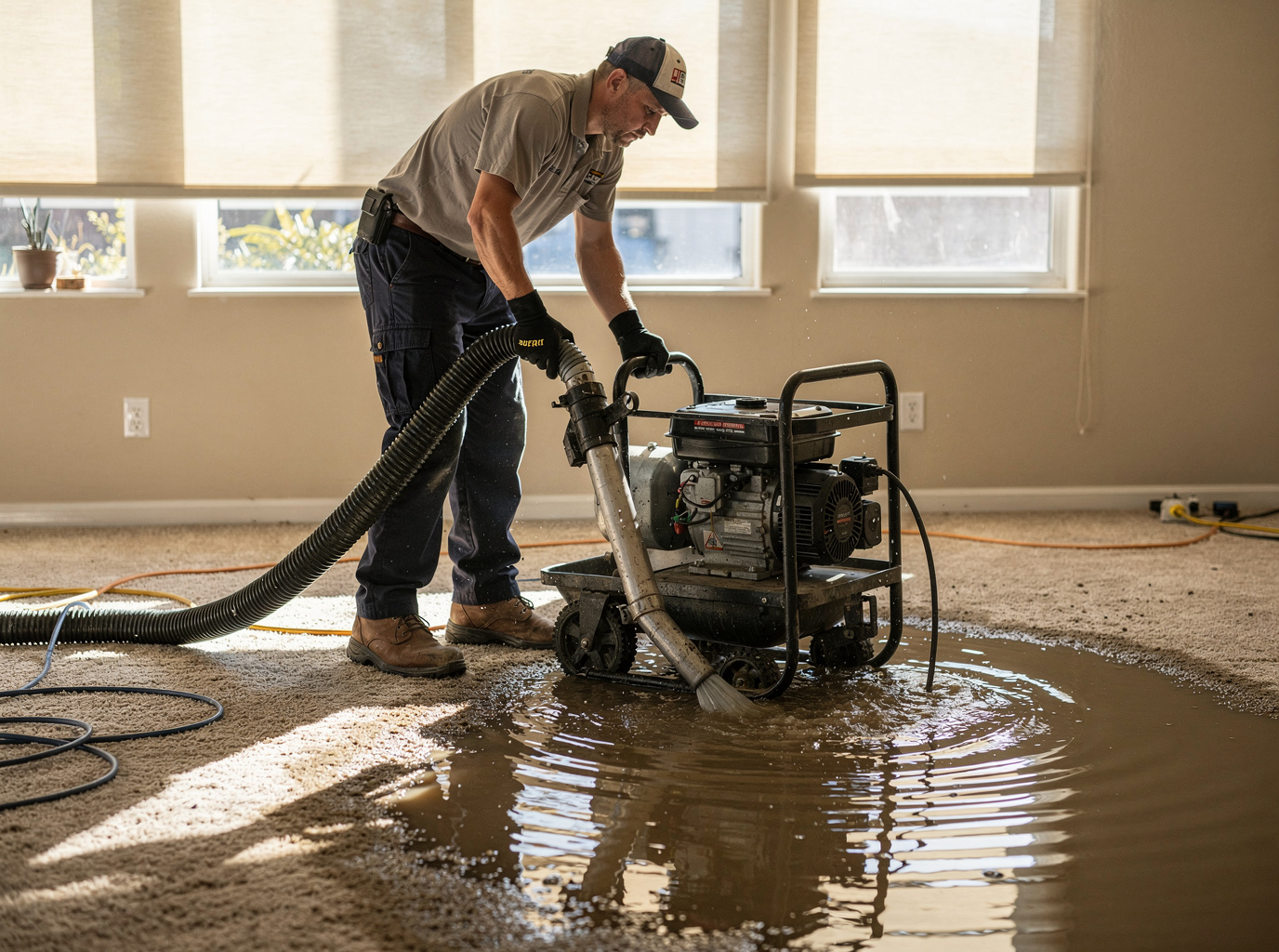
In San Bernardino's older housing stock around Downtown and Del Rosa, slab foundations and stucco exteriors trap water against framing after pipe bursts or roof leaks. Hot summer temperatures above 100 degrees accelerate evaporation on surfaces but drive moisture deeper into drywall and subfloors, raising mold risk within 24 to 48 hours. Technicians must pull baseboards early and use moisture meters on concrete to map hidden saturation before it migrates toward California State University San Bernardino campus buildings or nearby commercial strips.
Flash flooding from monsoon storms often affects lower-lying streets in Muscoy and Verdemont where drainage ditches overflow. Emergency crews deploy truck-mounted extractors first on carpet and pad, then switch to air movers angled at 45 degrees across hardwood to prevent cupping. In Arrowhead and Highland, hillside homes with crawl spaces require dehumidifiers rated for 150 pints daily because the desert air holds little ambient moisture once the initial water is gone, forcing longer run times than jobs in nearby Colton or Redlands.
Code requirements in San Bernardino County call for negative air machines when Category 2 water contacts porous materials near electrical panels. Skipping this step risks corrosion on wiring in 1960s-era homes common throughout the area. Crews document every affected room with photos and meter readings before leaving equipment overnight, because returning the next day in 105-degree heat reveals whether drying targets have been met or if additional wall cavities need opening.
Technician insight
In San Bernardino the thing that catches most people out with Emergency Water Removal is how quickly 105-degree afternoons push moisture from wet carpet into the paper facing of drywall in 1950s Downtown homes. Homeowners often shut off the water but leave the carpet in place, and by the time we arrive the next morning the damage has already traveled under the tack strip toward the slab edge.
Arrowhead pipe burst after monsoon
A supply line failed in an Arrowhead home during a summer storm, sending water under the living room slab. Extraction removed surface water the same afternoon, then drying equipment ran for three days to pull moisture from the concrete before it reached the adjacent kitchen. Final meter readings confirmed the framing was dry enough to avoid opening walls.
Emergency Water Removal Services We Offer
✓Slab Leak Water Extraction
Removes standing water from concrete slab leaks common in Del Rosa and Downtown homes before moisture migrates under adjacent flooring.
✓Crawl Space Flood Removal
Extracts water and installs drying systems in hillside crawl spaces found in Verdemont and Muscoy after heavy rains or pipe failures.
✓Carpet and Pad Extraction
Pulls saturated carpet and underlayment in Arrowhead and Highland residences to stop wicking into baseboards and drywall.
✓Emergency Structural Drying
Sets up industrial air movers and dehumidifiers in hot San Bernardino summers to dry framing and subfloors within 48 hours.
✓Basement Water Removal
Handles below-grade flooding in older Highland properties near Glen Helen Regional Park using submersible pumps and perimeter drying.
Emergency Water Removal Cost in San Bernardino, CA
| Service | Typical Range | What Affects It |
|---|---|---|
| Initial extraction visit | $250–$550 | Depends on water depth and access in older slab homes |
| Daily equipment rental | $150–$300 | Higher in peak summer due to longer drying times |
| Crawl space drying package | $400–$800 | Includes extra dehumidifiers for hillside properties |
| Category 2 water handling | $100–$200 | Added for negative air setup near electrical panels |
Ranges are typical for San Bernardino, CA and confirmed with an exact written quote before any work starts.
How it works
- 1
On-Site Assessment
Technicians arrive from the Benedict Street location, map water migration through walls and floors using meters, and identify safety hazards in the affected San Bernardino neighborhood.
- 2
Water Extraction
Truck-mounted and portable extractors remove standing water from carpets, pads, and hard surfaces before desert heat drives moisture deeper.
- 3
Drying Equipment Setup
Air movers and dehumidifiers are positioned to target wet materials while negative air is established if needed near electrical systems.
- 4
Daily Monitoring
Return visits check moisture levels and adjust equipment until readings reach acceptable levels for the local climate.
Pricing
Pricing varies by water volume, affected square footage, and number of drying days required in summer heat.